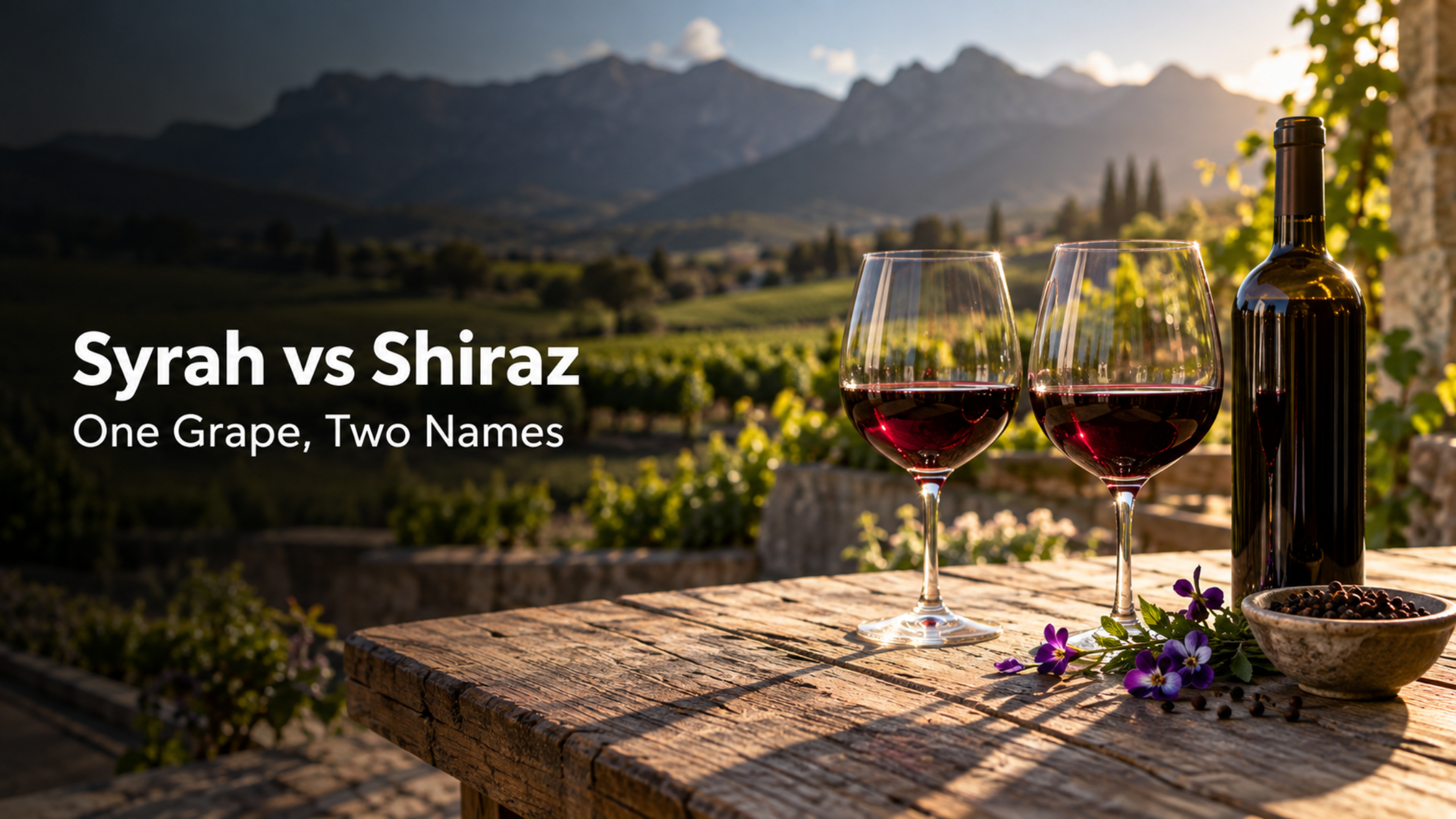
Stand in front of any South African wine shelf and you’ll see it. One bottle says Shiraz, the one beside it says Syrah, and the prices and back labels give you no clear reason why. Guests at our tasting lounge ask about it all the time, usually while holding a glass of one and wondering whether they’d prefer the other.
The question matters more now than it did twenty years ago. South African red wine has changed a great deal, and the word a winemaker puts on the label has become a small signal about what’s in the bottle. With braai season starting and red wine moving back outdoors, it’s worth knowing how to read that signal.
Are Syrah and Shiraz the same grape?
Yes. They are the same variety under two names. The grape’s botanical name is Syrah, and it was first documented in France’s Northern Rhône. The idea that it came from the Persian city of Shiraz has been disproved: DNA testing showed the variety is indigenous to France.
The name Shiraz came from Australia. When James Busby brought cuttings there in 1832, the labels are thought to have read “Scyras”, and the spelling and pronunciation drifted over time into “Shiraz”. The Australian wines became so successful that the name followed them to other warm-climate countries, South Africa among them
So why do South African winemakers choose one name over the other?
The name is mostly a statement of style. Both names are legal in South Africa, and the choice usually reflects what the producer is aiming for. Broadly:
- Shiraz suggests the Australian model. That style is generally richer and riper, fuller in body and alcohol, and often matured in American oak.
- Syrah nods to the Rhône. It is associated with cooler, more temperate regions where perfume, floral notes and peppery spice are the aim.
The split is also a sign of how South African wine has matured. Andre van Rensburg was the first South African winemaker to apply to use the name Syrah, for his Stellenzicht Syrah 1994. Before that, Shiraz was the only option. Since then the Rhône-inspired style has grown steadily. In a 2020 Decanter tasting of 78 premium Cape examples, the most exciting wines were almost all labelled Syrah, and they tended to be fresher and more savoury.
Does the name on the label guarantee the style?
No, and this is the part most guides leave out. The choice between Syrah and Shiraz has no official or legal basis. It is a winemaker’s shorthand, not a regulated category. A wine labelled Syrah can still be generous and powerful. Some producers choose the French name simply because they prefer it, or because it fits the story of their site.
Our own Union shows this well. It carries the name Syrah and has the floral lift and mineral tension you’d associate with the Rhône, but it is not a light wine. At 14.75% alcohol, with concentrated fruit from very low-yielding vines, it has real power. So read the name as a first hint, then look at the region, the alcohol and the tasting notes for the rest of the picture.
How do you tell what’s in the bottle before you open it?
Look at four things on the label, roughly in this order:
- The region. Cooler coastal or high-altitude sites usually give more peppery, savoury wines. Warmer inland valleys lean towards ripe, dark fruit.
- The alcohol. Around 13 to 13.5% often points to a fresher style. Past 14.5% usually means riper fruit and more weight.
- Oak and maturation notes. Lots of new oak adds vanilla and polish. Seasoned or neutral barrels let the fruit and spice come through.
- The winemaker’s descriptors. Words like violet, pepper and savoury point one way. Jammy, plush and chocolate point the other.
After a few bottles, you’ll find you can place a wine on the spectrum quickly, whatever name it carries.
How do Paserene’s two Syrahs compare?
We make two wines from this grape, and they show two sides of it.
Paserene Union 2020 is our flagship Syrah. It comes from arid, shale-rich Glenrosa soils in Tulbagh, where the vines yield only around two tons per hectare. It was fermented in small open-top vessels and spent 22 months in a mix of new, second-fill and neutral oak. After that it had a further year in bottle before release, and it was bottled unfiltered. On the nose you’ll find plum compote, crushed violets, star anise, charcoal and dark minerals. Only 2,187 bottles were made, and it has the structure to age for 25 to 30 years.
The Dark 2019 belongs to our Elements Range, the more playful side of the estate. It’s youthful and spicy, and it’s the one to open now, midweek or at a Saturday braai, while Union rests in the cellar.
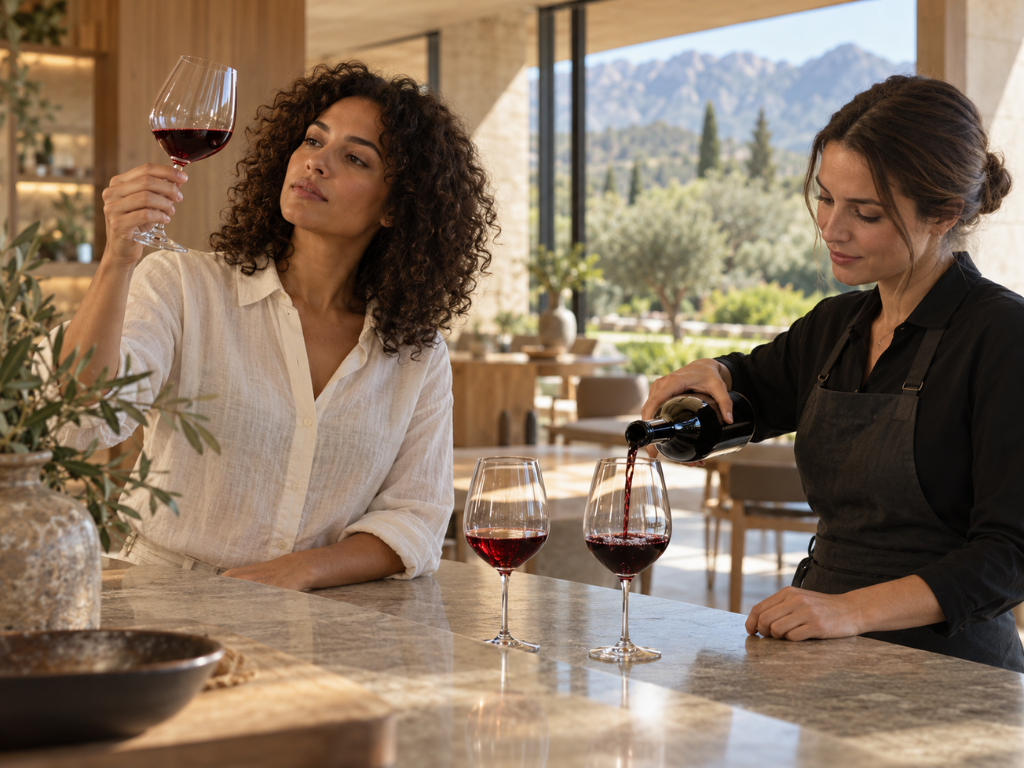
Tasting them side by side at the lounge is the quickest way to feel how much style and site can shape one grape.
What should you eat with Syrah?
Syrah loves smoke, spice and slow cooking, which makes it one of the most natural braai wines there is. Try it with:
- Lamb chops or a butterflied leg of lamb straight off the coals
- Boerewors and grilled mushrooms with a peppery sauce
- Braised oxtail or lamb shank as the evenings stay cool
- Duck with plum sauce, or spiced Cape Malay dishes that aren’t too hot
- Aged, nutty cheeses to finish
One practical note for South African spring and summer: serve it slightly cooler than room temperature. A bottle that sat on the braai side of the stoep all afternoon will taste flat and alcoholic. Our guide to serving temperatures for South African wines explains why, and our Elements Range food pairing guide has more local pairings.

Why does place matter so much for this grape?
Syrah is one of the most expressive grapes for showing where it was grown. The same variety can taste of black pepper and violets in one valley and ripe plum and chocolate in another. That’s why a Tulbagh Syrah and a Swartland or Stellenbosch Syrah can feel like different wines. It’s the same idea we explored in South African Wine and the Meaning of Place, and it starts in the vineyard long before harvest. You can see that season begin in our note on spring bud break in the Cape Winelands.
FAQ
Is Syrah the same as Shiraz?
Yes. Both names refer to the same grape variety. The difference lies in the style a winemaker is signalling, not in the grape itself.
Which is better, Syrah or Shiraz?
Neither is better. The Shiraz style tends to be riper and fuller. The Syrah style tends to be more peppery, floral and savoury. Choose by what you enjoy and what you’re eating.
Is Shiraz sweet?
Most Shiraz is dry. Ripe fruit and oak can give an impression of sweetness, but there is usually very little residual sugar. Union, for example, has just 2.2 g/l.
How long can South African Syrah age?
Everyday styles are best within a few years. Structured, concentrated examples like Paserene Union can develop for decades. We estimate 25 to 30 years for the 2020.
Should Syrah be served chilled?
Lightly. Slightly below room temperature, roughly 16 to 18°C, keeps it fresh and balanced, especially in a warm South African summer.
Taste the difference for yourself
The best way to settle the Syrah and Shiraz question is in the glass. Visit our tasting lounge in Franschhoek, open daily from 10am to 5pm, and ask to taste through our reds. Or shop Paserene wines online and have Union and The Dark delivered for a side-by-side tasting at home.