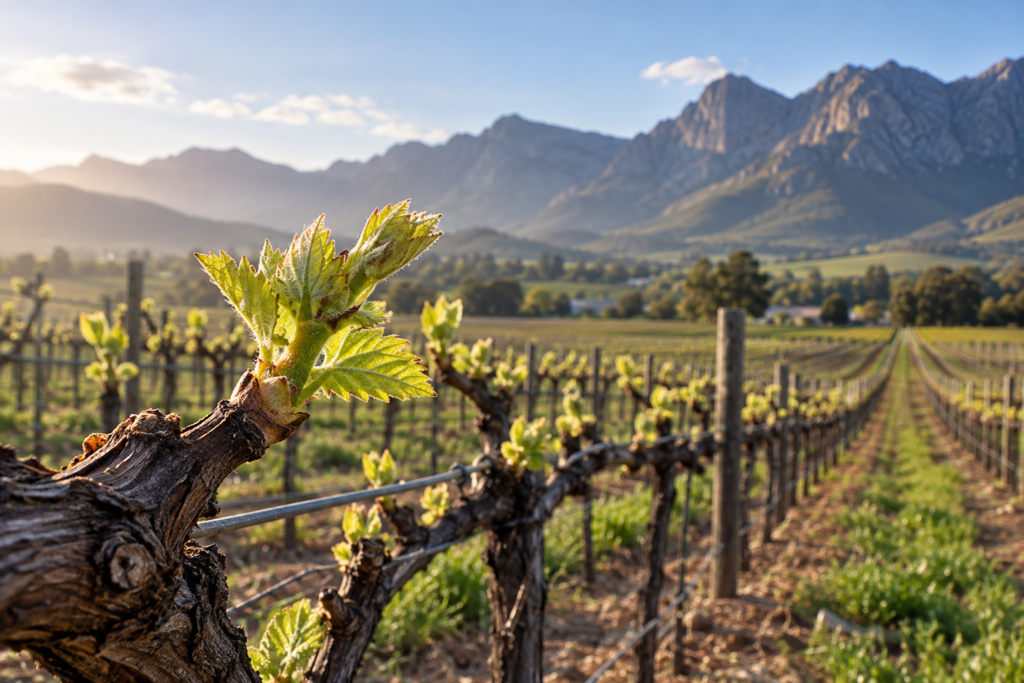
Bud break is the moment each September when the vines around Franschhoek stop looking like bare wood and start looking like a vineyard again. Tiny green shoots push through nodes that have sat dormant since May, and within a fortnight the rows fill out with fresh leaf. It’s the unofficial start of the growing season, and the weeks around it tell you more about the vintage ahead than almost anything else on the calendar.
For anyone used to a Northern Hemisphere wine calendar, this takes a moment to reorient. While European vineyards head into harvest in September, Cape vineyards are just waking up. It’s one of the quieter pleasures of working with South African wine: the seasons run backwards from what most wine writing assumes, and Franschhoek in spring looks nothing like a postcard “harvest month.”
What actually triggers bud break in the vineyard?
Vines spend the Cape winter dormant, living off reserves stored in the roots and trunk the previous autumn. As soil and air temperatures climb through August and into September, sap starts moving again and the swollen buds at each node begin to split open. Wines of South Africa’s own growing season calendar places this spring stage from September through to November across the country’s wine regions, with flowering following toward the end of October. Franschhoek’s cooler mountain pockets tend to run a little later than the warmer inland valleys, which is one of the small, local variables that make every vintage here slightly different before a single grape has even set.
Why does the timing of bud break actually matter?
An even bud break across a block generally leads to even flowering, and even flowering leads to a more uniform crop at harvest. A messy start, with buds pushing at wildly different times across the same row, tends to cause exactly the kind of uneven ripening that keeps a winemaker up at night in April. It’s a small detail in September that quietly shapes decisions made six months later. Jancis Robinson’s South African vintage notes make this point vintage after vintage: the years that struggled usually had trouble early, not only at harvest.
Is frost still a risk once the vines have budded?
Yes, and it’s arguably the most stressful few weeks of the growing calendar for that reason. Newly emerged shoots are soft, pale green and completely undefended against cold. A late frost in September or even early October can wipe out a season’s worth of primary buds on exposed blocks overnight. Cape growers watch overnight temperature forecasts closely through this period, and low-lying or frost-prone sites are usually the first ones checked at dawn.

Should you plan a wine estate visit during bud break season?
It’s one of our favourite times to have guests through, if I’m honest. September brings a different rhythm to Franschhoek: fewer tour buses in the car park, tasting room staff with more time to actually talk you through a glass, and vine rows that look almost sculptural against the bare soil and new green growth. Just don’t expect to taste anything made from what you’re looking at outside the window. Wine from this year’s harvest won’t be bottled and released for well over a year, so what’s in your glass on a spring visit is a previous vintage doing the talking. If you’d like to see the season for yourself, our Franschhoek wine tasting experience runs right through spring.
What can visitors actually see happening in the vines right now?
Look closely at the pruned canes and you’ll notice small, felted buds swelling at each node, almost fuzzy to the touch before they open. Within days they split to reveal a tight cluster of pale green leaves, and not long after that the first tiny flower clusters appear tucked in among them, months before anyone would call them grapes. It’s a slower, quieter kind of spectacle than harvest, but it’s the reason a vintage succeeds or struggles later, and it says something about how closely a vineyard needs to be watched. You can read more about how we approach that work on our estate page.
Whatever vintage ends up in the bottle next year, the wine you can buy from us right now already carries the imprint of a season like this one. If you’re curious to taste where a good Cape spring eventually leads, our current range is available to browse and buy online.
FAQ
When does bud break happen in South Africa?
Bud break usually begins in September as spring temperatures rise, though the exact timing shifts from year to year and even from block to block within the same vineyard.
Why does bud break matter for the eventual wine?
An even, well-timed bud break tends to lead to more uniform flowering and ripening later in the season, which has a direct bearing on both yield and quality at harvest.
Can frost still damage vines after bud break?
Yes. The new shoots are soft and unprotected, so a late spring frost in September or October can damage or destroy them on exposed sites, which is why growers keep a close eye on overnight forecasts through this period.
Is September a good time to visit a Franschhoek wine estate?
It can be an excellent time. Spring brings fresh growth to the vineyards and generally quieter tasting rooms than the summer peak, though remember the wine you’re tasting was made from an earlier vintage, not the season currently growing outside.